The James Hutton Institute in Invergowrie has been carrying out research on soft fruit production since the 1930’s as the ‘Strawberry Investigation Unit’ at the West of Scotland College of Agriculture in Auchincruive and the ‘Raspberry Disease Investigation Unit’ based in Dundee, which later became part of the Scottish Horticultural Research Institute (SHRI), then the Scottish Crop Research Institute (SCRI) and in 2011 the James Hutton Institute. For this event we met in the new ‘Crop Innovation Centre’ which was opened in 2024, built primarily to house the ‘International Barley Hub’ (IBH) and the ‘Advanced Plant Growth Centre (APGC) which secured the funds for this infrastructure development as part of the ‘Tay Cities Deal’. The core of the new facilities being molecular phenotyping, high-throughput phenotyping, controlled environment (climate change), crop storage, and vertical farming. Hutton research spans much wider subject areas across its main sites near Dundee and Aberdeen as well as its farms, but this visit focussed on just some of the soft fruit work.
Twenty-six of us sat down in the new auditorium where Susan McCallum started our presentations with an overview of all the soft fruit crops, the main issues being addressed and some of the technologies used and some outcomes. These included climate change, pests and diseases, changes in the market, costs and labour, all affecting breeding objectives. Her own current research focus was on blueberry production as hitherto Scottish growers had relied on varieties bred for other climates which were not necessarily well adapted to Scottish conditions. Carolyn Mitchell followed with a presentation focussing on the main insect problems of soft fruit crops, often as vectors of viral diseases. These included raspberry leaf and bud mite, large raspberry aphid and vine weevils, but she focussed mainly on spotted-wing drosophila and blueberry aphid. Currently she is looking also at the impact of various flowering plants on enhancing the efficacy of natural enemies in pest control. The third presentation was from Louise Gamble who looks after the high-health soft fruit facility, particularly Rubus and Ribes certification and pathogen diagnostics. This is vital for fruit propagation certification schemes, providing virus- free material for crop propagation as well as for research. Copies of these presentations are available to members.
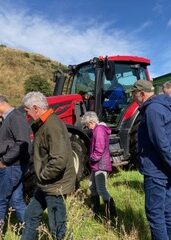
After some lively discussion we were led out to the field by Andrew Christie, the field manager for Mylnefield and Balruddery farms, to see the ‘Mean Steam Machine’ in action improving weed control using high pressure steam in the soft fruit breeding plots. This had won the Royal Highland & Agricultural Society of Scotland (RHASS) Innovation Commendation Award 2025 which was subsequently presented at the Royal Highland Show. It has been used also to facilitate pasture diversity improvement work at Hutton’s Glensaugh Farm (see poster pdf). Next, we navigated a hole in the hedge to visit the raspberry breeding polytunnels where Nikki Jennings gave a tour of the plots and the latest varieties being developed to meet the industry’s current needs.
Back to the ‘Crop Innovation Centre’ the institute canteen provided an excellent lunch while we continued to discuss what we had been shown with the presenters. A couple of groups were able to have brief tours of the new plant phenotyping facility recently commissioned in the centre.
The afternoon continued at Peter Arbuckle’s farm which was only a few hundred metres away across the A90 but necessitated driving west to Longforgan then through the underpass and back east to ‘Star Inn’ where Peter’s business is based. Once reassembled Peter gave us an introduction to his business and that of other parts of the Arbuckle family as well as his Polish business partners and staff, most of whom have been with them for many years. In fact, our next stop was about two miles north at what was his son’s farm where he had several hectares of honeyberries. This is a somewhat unusual crop for the Scottish soft fruit industry which they had started planting about eight years ago with planting material from Poland. The fruit are rather delicate and must be frozen as quickly as possible after machine harvest, and the market is not well established. Arbuckle’s farms are focussing on freeze-dried honeyberries as the least problematic form to handle and store.
On the same farm Peter’s son has established an innovative and rapidly expanding business called ‘Agricarbon’ which has developed machinery (see photo) and expertise to efficiently sample field soils and analyse their composition, focussing on carbon but also other soil health-relevant data. We were able to see the soil core sampling kit, and in the same barn Peter showed us his honeyberry harvester and freeze-drier facility.
Back to the Star Inn site Peter showed us his raspberry and strawberry production polytunnels and we discussed various aspects of changes in the systems of production over the years. Finally, we were given some strawberries and cream, conveniently right next door to the farm shop which sold many and varied products all based on the farming enterprise. Quite a lot of us bought some very tasty ‘souvenirs’!
Please see link below to access associated powerpoint and other presentation material

Author: Bill Spoor
BSc Agric Botany (Aberystwyth), PhD Plant genetics (Reading). Research interests focused on plant genetic resource conservation and utilisation with substantial research student engagement. Led to appointment as PG Director of Studies at the Univ. of Edinburgh whilst employed by SRUC (then SAC). Head of Crop and Soil Systems Group which was focussed on education delivery (U/G and P/G taught courses ), research in crop and soil systems (funded by SERAD and other Govt agencies, and commercial), and extension (Crop Clinic). Increasing involvement in organisational management via Dean of Centre and as Dean of Postgraduate Studies.