Regenerative Agriculture – 24th June 2025
An introduction to the visit with informative links was included in the invitation notice as follows:
“As previously intimated, the 116th meeting of the Scotia Club will have a regenerative agriculture theme with visits to two farm businesses in Fife.
First, we will visit Matt Waldie at West Gilston Mains Farm, New Gilston, Leven, KY8 5PH
See: https://www.facebook.com/4FrontFarmingCoLtd
Also: https://everydayclimatehero.org/matt-waldie
The second visit of the day will be to Douglas Christie at Durie Farm, Leven KY8 5RF
See: https://www.scottishlandandestates.co.uk/helping-it-happen/case-studies/regenerative-agriculture-durie-farms
Also: https://www.ourisles.co.uk/duriefarms”
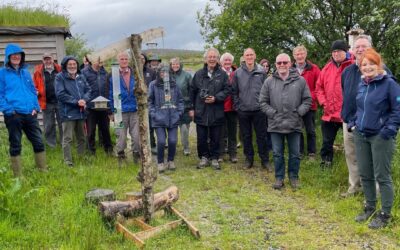
Nine members and guests travelled to Fife to join these visits. We were met at Gilston Mains Farm by Matt Waldie and Edward Baxter of 4 Front Farming Co Ltd (4FF). Matt started us off in the farm office with a presentation giving the background to 4FF and its rationale. His PowerPoint slides were later shared in confidence with members of the Scotia Club.
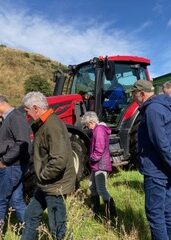
The 4FF company was formed in 2016, allowing several local farms to join forces to jointly achieve better resource use, economies of scale, greater profitability and enhanced sustainability. A key issue has been the 22% decline in soil organic matter on the farms observed over 23 years by Helena Black of JHI and the Agricarbon Company (see 115th visit on 10th June). The Company has been tackling this using regenerative practices: min till (photo of heavy drill direct below), cover crops, increased diversity and mob grazing of cattle (cover photo).
Next, the group travelled the farm by trailer to see the regenerative farming processes in action at Gilston Mains. Cover crops (a mix of grains, fodder crops and clovers) are drilled mid-May and can yield up to 50t fresh matter per Ha. This is sprayed off before or just after drilling. The winter crop is therefore direct drilled into considerable biomass using the heavy machinery pictured below. Main crops are oats (for Quaker) and winter wheat. Integrated pest management features beetle banks, hedgerows and no pesticides.
Yearling cattle are mob grazed on organic land, utilising cover crops in summer and wintering on grass outside. The grazed land forms an excellent entry for spring cereal crops. Contractors also notice the benefits of mobbed grazed cattle on the land before they sow carrots.
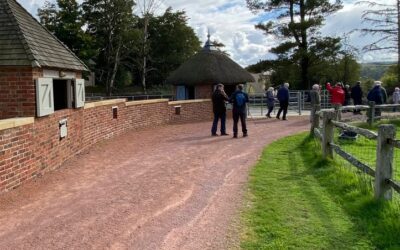
The group moved on to Durie farm for an outstanding lunch provided by Alison Christie (soup, a range of salads and excellent home bakes) in the impressive Durie house (photo of group entering Durie House below). After eating perhaps a bit too much, the group were treated to a trailer tour of the farm by Douglas Christie using a ‘vintage?’ 1977 MF135. Our second farm visit made an interesting ‘compare and contrast’ with the first and helped to illustrate the diversity and complexity of what constitutes ‘regenerative’ farming. Focus on the soil and direct drilling are common factors. At Durie a key management practice is companion cropping. For example, growing beans and wheat together reduces weeds and maintains soil nitrogen and resilience. Grains are separated after harvest and drying. Again, mob grazing of cattle is a prominent feature (photo below). Half the farm is organic. Conversion and fencing subsidies are an important aspect of this, reducing risk and allowing more of the necessary experimentation to arrive at a system that fits the unique soil, climate and business circumstances of the farm. There is no ‘blueprint’ for regenerative farming. Both farms therefore draw heavily on the agricultural research community at SRUC, JHI, Rothamsted etc. for guiding principles. Many thanks to our hosts for an enjoyable and very informative day.
Alistair Stott
4th July 2025



Author: Bill Spoor
BSc Agric Botany (Aberystwyth), PhD Plant genetics (Reading). Research interests focused on plant genetic resource conservation and utilisation with substantial research student engagement. Led to appointment as PG Director of Studies at the Univ. of Edinburgh whilst employed by SRUC (then SAC). Head of Crop and Soil Systems Group which was focussed on education delivery (U/G and P/G taught courses ), research in crop and soil systems (funded by SERAD and other Govt agencies, and commercial), and extension (Crop Clinic). Increasing involvement in organisational management via Dean of Centre and as Dean of Postgraduate Studies.